1. Sleep can become lighter with age.
Sleep architecture shifts across adulthood. The latter half of the night consists of lighter stage sleep, meaning small sounds, temperature shifts, or passing thoughts are more likely to surface you.
From changing hormones to everyday habits, here’s what could be interrupting your sleep—and how to narrow it down.
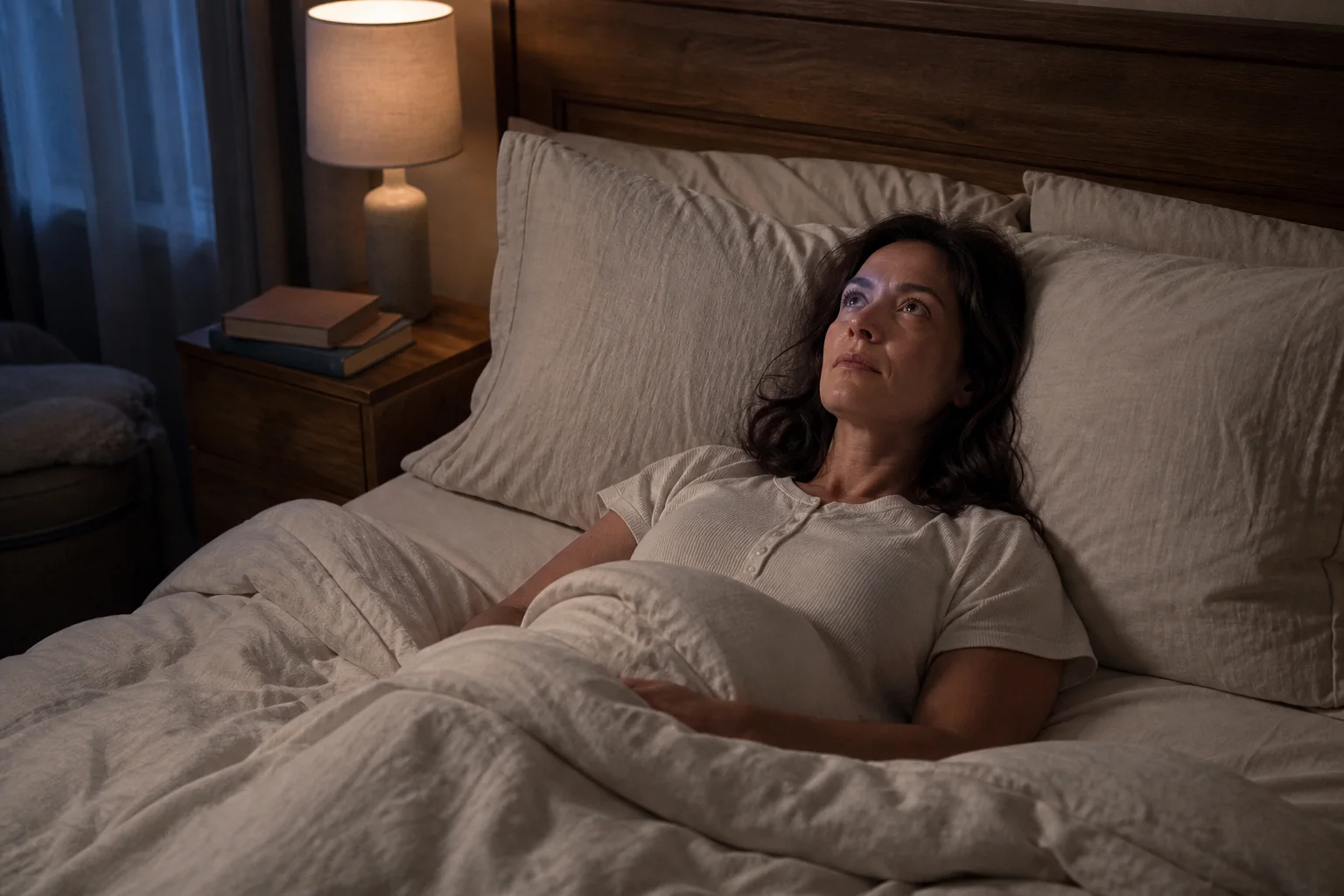
The short version: waking at the same hour can have more than one contributor. The useful question is what pattern surrounds it.
If you know the exact time without checking, you are not alone. But “3 a.m. waking” is a description, not a single condition. Your pattern may involve your room, schedule, stress, life stage, habits, health, or more than one of these at once.
Use these prompts as a short observation guide. They are not a diagnosis, and you do not need to force yourself into a single box for the guide to be useful.
Sleep architecture shifts across adulthood. The latter half of the night consists of lighter stage sleep, meaning small sounds, temperature shifts, or passing thoughts are more likely to surface you.
Hormone fluctuations, night sweats, and room thermoregulation can disrupt continuous sleep. Notice whether you wake warm, clammy, or chilled. Breathable cooling bedding and maintaining a room temperature between 65°F and 68°F can make an immediate difference.
Stress isn't always panic. Often it looks like mentally reviewing tomorrow's calendar, replaying a conversation, or checking items off a mental list the moment the house is quiet.
Seeing 3:07 AM immediately triggers mental arithmetic: "If I fall asleep right now, I get 3 hours and 15 minutes." Turn the clock face away from the bed to prevent sleep anxiety loops.
Alcohol acts as a sedative initially, but as liver enzymes metabolize it around 3–4 hours later, it triggers a rebound arousal that fragments REM sleep.
Caffeine has an average half-life of 5 to 7 hours. Even if you fall asleep fine, residual caffeine can diminish slow-wave deep sleep and cause abrupt mid-night awakenings.
Many readers replace late alcohol or chamomile tea with a structured, melatonin-free nightly drink formulated with tart cherry, magnesium glycinate, and L-theanine.